Arvo
Validating product–market fit for a workplace disengagement app
My Role
UX Researcher
Timeline
3 Weeks
Team
4-Person Team
Tools
Figma, Interviews
"The deliverables were professionally done, with insights that directly inform the next strategic moves for Arvo."
— Eileen Z, Founder
Project at a glance
Arvo is an early-stage startup with a B2C app that helps working professionals manage disengagement through job crafting and mindset shifts.
The founder had already spent a year building the product and wanted validation: Is this solving a real problem? Is B2C the right model? Who is the true target user?
Through 15 interviews with professionals across industries, we found that most disengagement was driven by organisational factors users could not control. The core opportunity was not another coping tool, but a way to surface issues to leadership and make change possible.
I recommended that Arvo explore a B2B direction focused on anonymous feedback and leadership accountability. The founder is now actively evaluating this direction.
The challenge
Knowledge workers are burning out. Arvo's initial solution asked individuals to self-manage disengagement with reflections, exercises, and "job crafting" prompts.
However, early signals suggested a deeper question:
If disengagement comes from workload, culture, and leadership decisions, will a B2C coping app be enough?
The capstone brief was simple: Validate whether Arvo's current B2C app is solving the right problem for the right users, and identify strategic opportunities if not.

The original B2C interface: Users consistently reported feeling overwhelmed by the amount of text and information. "It feels like homework," one participant said.
Research approach
We interviewed 15 professionals experiencing disengagement across tech, finance, healthcare, legal, and hospitality.
Mid-career (3–10+ years experience)
Early-career (0–2 years experience)
Early-career participants were still forming a baseline of what "normal" work looks like, so we focused our analysis on mid-career professionals who could clearly describe patterns over time.
Methods:
- •Semi-structured 1:1 interviews (remote)
- •Affinity mapping to cluster pain points, behaviours, and mental models
- •Synthesis into key themes, opportunity areas, and strategic recommendations
Key insight: 90% organisational, 10% individual
Across 15 interviews, 12 participants identified organisational factors as their primary disengagement drivers.
Most common themes:
- •Unrealistic workload and understaffing (11 of 15)
- •Management challenges and misalignment (9 of 15)
- •Limited autonomy or decision rights (8 of 15)
- •Low psychological safety and fear of speaking up (7 of 15)
One participant summarised it simply: people are not choosing disengagement, they are being worn down by the system.
This revealed the core gap:
- •Arvo focused on individual mindset and coping
- •The real levers sat with workload, structure, culture, and leadership
A purely B2C self-help product would struggle to move the outcomes people actually cared about.
Three key findings
Mid-career professionals already know how to cope
All 11 mid-career participants had built their own coping systems:
- •Setting boundaries or "quiet quitting"
- •Cognitive reframing and mindset work
- •Seeking mentors, peer support, or external coaches
- •Planning exits and keeping options open
One participant said they would prefer a human coach who can give direct feedback and draw from experience.
Implication
The problem is not a lack of coping strategies. A standalone coping app risks feeling redundant. What users actually want is for the environment to change, not just their reaction to it.
The manager paradox
Most participants saw their managers as important, but constrained.
Patterns we heard:
- •Around one in four managers were described as clearly ineffective or harmful
- •Only one manager in the sample was both willing and empowered to make meaningful changes
- •The rest wanted to help but were limited by headcount, budgets, or senior leadership
Implication
Interventions that stop at the manager level will hit a ceiling. To address structural drivers of disengagement, solutions need to reach decision-makers who control workload, policies, and resourcing, not just line managers.
Trust determines B2B viability
When we asked about company-provided feedback tools, every participant split into one of two camps:
High psychological safety
"I'd be open to using a feedback tool if leadership actually follows through."
These participants had seen follow-through before and believed their feedback mattered.
Low psychological safety
"Even if it's anonymous, I don't trust it. People get singled out anyway."
These participants had seen negative consequences or felt their input had been ignored.
Implication
A B2B feedback product can only succeed in organisations that have already built a foundation of trust and accountability. If those conditions don't exist, the tool itself won't fix them.
Design exploration: B2B concepts
Using these findings, we explored what a B2B feedback and accountability product could look like. I helped define core flows across three views.
Redesigned B2B feedback system
The complete B2B system: From anonymous employee feedback to actionable leadership insights. Click any screen to enlarge.
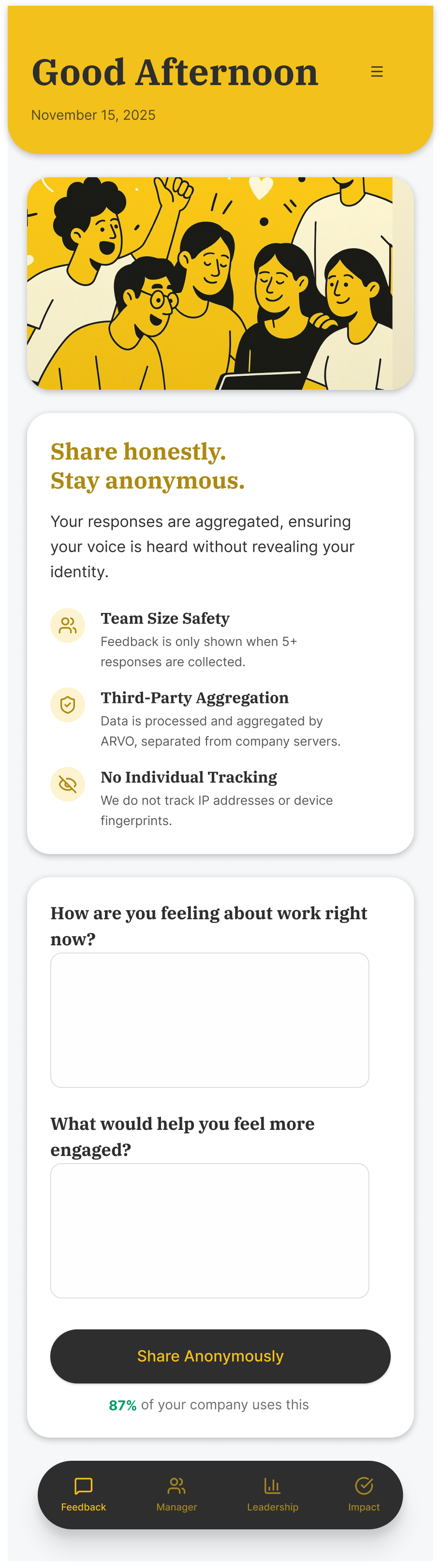
Anonymous feedback
Goal
Make it feel safe and worthwhile to share honest feedback.
Key elements:
- •Clear messaging that emphasises anonymity and third-party handling
- •Simple, open prompts such as "How are you feeling at work?" and "What would help?"
- •Explanations of how responses are grouped and when employees can expect to see outcomes
The design focused on reassurance: short flows, minimal friction, and strong privacy language.
Team pulse and escalation
Goal
Help managers understand themes they can act on, and escalate what they cannot.
Key elements:
- •Weekly team engagement score with trends over time
- •Aggregated themes such as Communication or Career path, with example comments
- •An "Escalate to leadership" pathway for issues like workload or structural constraints
- •A simple "Recent actions" area to track what has been done and what is pending
This view positioned managers as partners rather than bottlenecks, while acknowledging their limits.

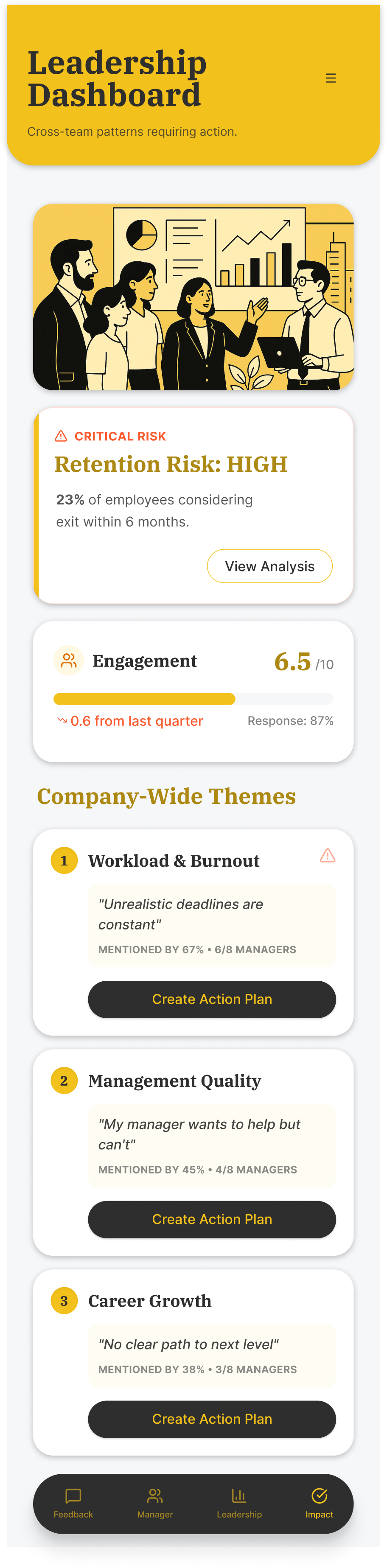
Company-wide patterns and risk
Goal
Give leaders a clear picture of risk and a path to respond.
Key elements:
- •Retention risk indicators by department and demographic segment
- •Company-wide themes such as Workload and burnout, Management quality, and Career growth
- •Trend comparisons across quarters to track progress
- •"Create action plan" calls to action linked to specific themes and owners
The design made it harder to ignore patterns by making them visible, comparable, and tied to follow-up actions.
Explore the Interactive Prototype
Experience the three-tier feedback system and see how design decisions support organisational change.
Best viewed on mobile
View Prototype →Outcomes
Although this was a capstone project rather than a live product launch, the work led to concrete shifts:
- •Arvo's founder gained clarity that the current B2C direction may not address the core drivers of disengagement.
- •The team delivered a research report, key themes, and initial B2B concept flows that the founder is now using to inform next steps.
- •The project reframed Arvo from "an app that helps individuals cope" to "a system that could help organisations face the real issues."
Reflection
Early validation is valuable
Catching a strategy mismatch after three weeks of research is far cheaper than discovering it after more years of building. This project reinforced how user research can de-risk not just features, but whole business directions.
What I would do next
If I had more time, I would:
- •Interview HR leaders and executives to understand B2B appetite, procurement cycles, and success metrics
- •Test low-fidelity versions of the feedback and reporting flows with both employees and managers
- •Explore how Arvo could integrate with existing HRIS or engagement tools instead of competing with them directly
This project deepened my interest in research that influences product strategy, not just UI decisions.
Want to see more?
Explore other projects or get in touch to discuss design opportunities.